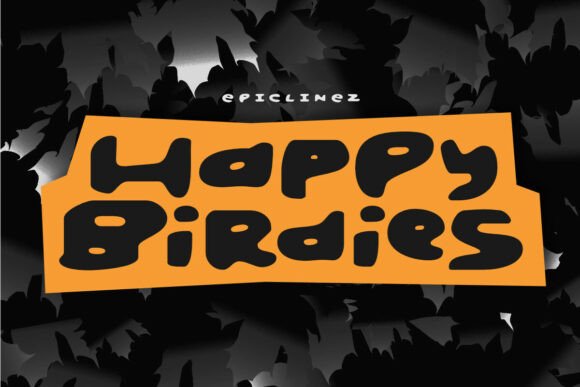
Evaluating Happy Birdies: A Practical Guide to a Playful Display Typeface
In the realm of graphic design, selecting the right typeface is often the difference between a message that resonates and one that falls flat. For projects requiring a sense of whimsy, warmth, and unbridled joy, Happy Birdies has emerged as a compelling option for designers seeking to inject personality into their work. This article examines the characteristics of this font, compares it against broader typographic categories, and helps you determine if it aligns with your specific design objectives.
Understanding the Design Philosophy of Happy Birdies
Happy Birdies is not merely a collection of letters; it is a visual representation of energy and childhood wonder. The typeface is defined by its bold, chunky strokes and a bouncy rhythm that mimics the lively movement of chirping birds. Unlike standard sans-serif or serif fonts that prioritize strict legibility at small sizes, Happy Birdies prioritizes character and emotional impact. Each glyph feels round and full of happy energy, designed specifically to stand out in display applications rather than body text.
The distinctiveness of this font lies in its PUA (Private Use Area) encoding. This technical feature allows the font to include a wide array of glyphs, swashes, and alternate characters without conflicting with standard keyboard layouts. For a designer, this means effortless access to decorative elements that can transform a simple headline into an engaging visual statement. Whether used for a toy label, a classroom banner, or a brand identity, the font adds a warm, friendly touch that is difficult to achieve with more utilitarian typefaces.
Comparing Happy Birdies to Standard Rounded Fonts
When evaluating Happy Birdies, it is helpful to place it within the context of other rounded and playful typefaces available in the market. Many "bubble" or "chunky" fonts exist, but they often lack the nuanced variation found in this specific design. Standard rounded fonts frequently rely on uniform stroke widths and predictable curves, which can sometimes result in a generic or dated appearance.
In contrast, Happy Birdies introduces a level of irregularity that feels hand-drawn yet polished. While a generic rounded font might look like a digital default, Happy Birdies retains a human element through its bouncy rhythm. This makes it particularly effective when compared to rigid geometric sans-serifs that are often used for children's products but fail to convey genuine emotion. The tradeoff here is specificity: while a standard font offers versatility across many mediums, Happy Birdies is optimized for high-impact, short-form messaging where personality is paramount.
Technical Considerations: PUA Encoding vs. Standard Layers
A critical factor in comparing Happy Birdies to other resources is its encoding method. Many modern fonts utilize OpenType layers or stylistic sets accessed through specific software menus. Happy Birdies, however, leverages PUA encoding. This approach ensures that all special glyphs and alternates are accessible across a wider range of applications, including those that may not fully support advanced OpenType features.
For the average user or a professional working across multiple platforms, this offers a significant advantage in workflow efficiency. You do not need to navigate complex menus to find a swash or an alternate character; they are often mapped directly to the keyboard or easily selectable. However, designers accustomed to granular control via OpenType features should note that PUA encoding requires familiarity with specific input methods or character maps. It is a different approach to customization, one that prioritizes accessibility over automated contextual substitution.
Best-Fit Scenarios and Limitations
Identifying the right use case is essential for maximizing the potential of any typeface. Happy Birdies excels in environments where the goal is to evoke immediate positive emotions. It is an ideal choice for:
- Kids' Projects and Storybooks: The round, friendly shapes are inviting to young readers and fit seamlessly into illustrations featuring animals or nature themes.
- Product Packaging: For toys, snacks, or educational materials, the font helps the product stand out on a crowded shelf by communicating fun before the consumer reads the details.
- Posters and Event Banners: Its bold weight ensures readability from a distance, while the playful style captures attention quickly.
- Cheerful Brand Identities: Startups or businesses focused on family services, childcare, or creative workshops can use this font to establish a welcoming tone.
However, there are clear limitations to consider. Because Happy Birdies is a display font, it is not suitable for long paragraphs of body text. The intricate details and heavy strokes can cause eye strain when read in large blocks. If your project requires extensive copy, such as a website article or a book chapter, you will need to pair this font with a highly legible secondary typeface. Additionally, while the font is excellent for print and digital displays, very small sizes (below 10pt) may lose some of their definition due to the chunky nature of the strokes.
Decision Factors: When to Choose Alternatives
While Happy Birdies is a robust tool for specific design challenges, it is not a universal solution. Evaluating whether to proceed with this font or explore alternatives depends heavily on the tone you wish to convey.
If your brand identity relies on minimalism, luxury, or corporate seriousness, Happy Birdies may feel incongruous. In these cases, a clean, geometric sans-serif or a classic serif would be a more appropriate choice. Similarly, if the target audience is strictly adult-oriented in a formal context, the childish charm of this font could undermine the credibility of the message. The "bouncy" quality that defines the font is its greatest strength in casual settings but becomes a liability in formal communications.
Another decision factor is the need for multilingual support. As with many specialized display fonts, Happy Birdies may have limited character sets compared to comprehensive system fonts. If your project requires extensive language coverage beyond the Latin alphabet, you must verify the glyph availability before committing. In scenarios where broad linguistic compatibility is non-negotiable, a more standard font family might offer better long-term value.
Practical Application and Pairing Strategies
To get the most out of Happy Birdies, consider how it interacts with other design elements. Because the font is so expressive, it often works best when given plenty of white space. Overcrowding the letters can diminish their individual character. When creating a logo or a poster, allow the words to breathe so the "happy energy" can truly fly off the page.
Pairing is another crucial aspect of implementation. Since Happy Birdies carries the weight of the design's personality, the supporting typography should be neutral. A simple, clean sans-serif like Helvetica, Arial, or Roboto provides a stable foundation that lets the main headline shine without competition. Avoid pairing it with other decorative or script fonts, as this can create visual chaos and reduce overall legibility.
Furthermore, leverage the PUA-encoded features strategically. Do not apply every alternate character indiscriminately. Instead, use swashes and unique glyphs to highlight key words or initials. This selective application maintains the balance between playfulness and professionalism, ensuring the design remains sophisticated even while being fun.
Conclusion: Making an Informed Choice
Choosing a font is a strategic decision that impacts how your message is perceived. Happy Birdies offers a distinct blend of boldness, playfulness, and technical convenience through its PUA encoding. It is a powerful asset for designers working on projects aimed at children, families, or brands seeking to project warmth and joy. However, its effectiveness is tied to specific contexts where display usage is the priority.
By understanding its strengths—such as its lively character and ease of access—and acknowledging its limitations regarding body text and formal tones, you can make a well-informed decision. Whether you are designing a storybook, a toy label, or a cheerful brand identity, evaluating Happy Birdies against your project requirements ensures that your final design not only looks good but communicates exactly what you intend.