Kapten Display Font: An Evaluation of Its Aesthetic and Utility
In the landscape of digital typography, display fonts serve a distinct purpose: they are designed to command attention at large sizes rather than facilitate long-form reading. Kapten is a display typeface that occupies a specific niche within this category, characterized by an aggressive, hand-painted aesthetic reminiscent of graffiti and street art. For designers and creative professionals, selecting a font like Kapten involves more than just appreciating its visual style; it requires an understanding of its structural limitations, its psychological impact on an audience, and the specific contexts where it performs effectively.
This evaluation examines the characteristics of Kapten, exploring why it might be selected for a project, the tradeoffs inherent in its design, and practical considerations for implementation. By analyzing its form and function, readers can determine whether this typeface aligns with their specific design goals or if alternative solutions would better serve their needs.
Understanding the Design Philosophy of Kapten
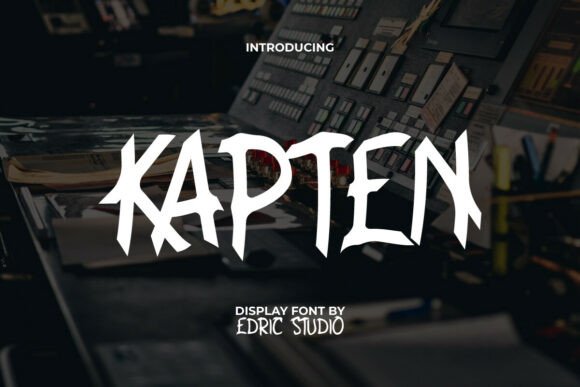
Kapten is defined by its deconstructed letterforms and chaotic structure. Unlike geometric sans-serifs or traditional serifs that prioritize uniformity and readability, Kapten embraces irregularity. The font features sharp, jagged edges and dramatically varying stroke widths, creating a visual texture that mimics the motion of a brush slashing across a surface. This handcrafted approach gives the impression of immediacy and urgency, as if the text was applied hastily in a rebellious act.
The character set is restricted to ALL CAPS, a common trait among high-impact display fonts. This constraint reinforces the sense of power and clarity, ensuring that every letterform contributes to a bold, unified statement. The mystery and refinement mentioned in its design brief are achieved through a balance of controlled chaos; while the strokes appear erratic, they maintain enough legibility to convey a message without dissolving into pure abstraction. For those researching urban typography, Kapten represents a bridge between raw street art aesthetics and professional digital application.
Reasons to Consider Kapten for a Project
Designers often seek out fonts like Kapten when standard typefaces fail to convey the necessary emotional weight. The primary reason to consider this font is its ability to communicate defiance, energy, and grit. In industries where the brand identity relies on breaking norms or challenging conventions, Kapten provides an instant visual shorthand for these values.
- Emotional Resonance: The jagged edges and uneven strokes evoke feelings of intensity and rebellion. This makes it effective for projects aiming to stir emotion or provoke a reaction.
- Visual Distinctiveness: In a saturated media environment, unique letterforms help content stand out. Kapten’s irregular structure ensures that headlines and titles are perceived as loud and uncompromising.
- Authenticity: For brands rooted in subcultures such as skateboarding, extreme sports, or underground music scenes, the hand-painted look of Kapten adds a layer of authenticity that clean, vector-based fonts cannot replicate.
Furthermore, the font's "high-octane" feel makes it suitable for dynamic visuals. When paired with action-oriented imagery, the kinetic energy of the letterforms complements the movement in the graphics, creating a cohesive narrative of speed and power.
Benefits and Tradeoffs
While Kapten offers significant stylistic advantages, its use comes with specific tradeoffs that must be weighed during the decision-making process. The most notable benefit is its versatility within its specific domain. It excels in creating focal points, making it ideal for movie titles, video game graphics, heavy metal album covers, and protest posters. In these contexts, the font acts as a visual anchor, drawing the eye immediately to the core message.
However, the very features that make Kapten striking also limit its utility. The dramatic variation in stroke width and the jagged nature of the letters reduce legibility at smaller sizes. Consequently, Kapten should not be used for body copy, captions, or any text requiring sustained reading. Attempting to use it for paragraphs will result in a frustrating user experience, as the eye struggles to track the irregular forms.
Additionally, the ALL CAPS restriction means that sentence case is impossible. While this is acceptable for short headlines, it limits the font's grammatical flexibility. Designers must ensure that the context supports a shouting tone; otherwise, the constant capitalization may feel jarring or overly aggressive. There is also a risk of visual fatigue if the font is overused. Because Kapten is so intense, it works best as an accent rather than a dominant voice throughout an entire layout.
Ideal Applications and Contexts
To maximize the effectiveness of Kapten, it is essential to match the font with appropriate mediums and audiences. The font is a strong fit for projects that demand a gritty, urban atmosphere. Specific scenarios where Kapten performs well include:
- Entertainment Media: Titles for action movies, thrillers, or horror films where tension and danger are key themes.
- Gaming and Esports: Logos, splash screens, and UI elements for competitive games that require a sense of adrenaline and competition.
- Musical Branding: Album art and tour posters for genres like punk, metal, or hip-hop, where the aesthetic aligns with the music's energy.
- Activism and Social Causes: Protest signs and campaign materials where the goal is to disrupt the status quo and demand attention.
In these situations, the font's chaotic structure supports the content's intent. The viewer expects disruption, and Kapten delivers it visually. The font becomes part of the story, reinforcing the message through its form.
When to Consider Alternatives
Despite its strengths, Kapten is not a universal solution. There are several situations where alternative typefaces would be more appropriate. If a project requires a sense of trust, stability, or calmness, the aggressive nature of Kapten would be counterproductive. Corporate communications, financial reports, healthcare branding, and educational materials generally benefit from cleaner, more neutral typefaces that prioritize clarity and accessibility over stylistic flair.
Furthermore, if the design system requires extensive text hierarchy beyond simple headlines, Kapten may not be sufficient. Designers needing a full family with multiple weights (light, regular, bold) and styles (italic, condensed) for varied applications should look toward more comprehensive font families. In cases where international audiences are the target, the stylized nature of Kapten could potentially hinder recognition for non-native speakers accustomed to standard Latin script forms.
Finally, consider the longevity of the design. Trends in street-style typography can shift. While Kapten captures a specific moment of urban culture, a more timeless design might be preferable for brands looking to establish a legacy that transcends current aesthetic fads.
Practical Decision-Making Insights
Before integrating Kapten into a project, designers should conduct a few practical tests. First, evaluate the font at the intended size. If the jagged edges cause the letters to blur or lose definition on screen or print, the size may be too small. Second, test the pairing with other typefaces. Since Kapten is so dominant, it usually requires a neutral partner—such as a simple sans-serif—for supporting text to create balance.
Consider the color palette as well. The high contrast inherent in the font's stroke variations works best with solid, bold colors. Subtle gradients or low-contrast backgrounds may diminish the impact of the hand-painted effect. Lastly, reflect on the brand voice. Does the brand speak with authority and defiance? If the answer is yes, Kapten is a viable candidate. If the brand voice is collaborative, gentle, or informative, the mismatch in tone could confuse the audience.
Ultimately, the decision to use Kapten depends on the alignment between the font's aggressive aesthetic and the project's strategic goals. It is a powerful tool for specific narratives but requires careful handling to avoid overwhelming the viewer or compromising readability. By understanding its capabilities and limitations, designers can harness the raw energy of Kapten effectively, ensuring that the final output is both memorable and functional.